Weber vs Traeger Pellet Smoker Test: Searwood vs Ironwood

For this Weber vs Traeger pellet smoker test, I bought the Traeger Ironwood XL and the Weber Searwood XL 600 with my own money, burned them in the same day, loaded them with the same pellets, and put them through the same backyard test.
No sponsorship. No free grills. No reason to hype one up over the other.
The plan was simple. Run both pellet smokers overnight with beef plate ribs, compare the bark, tenderness, smoke flavor, app experience, and overall cook, then crank them up and see how they handle ribeye steaks.
At the end of the test, I had to decide which one I would actually keep.

Watch the Weber vs Traeger Video
Weber vs Traeger Pellet Smoker: What I Tested
For this comparison, I wanted to keep it as fair as possible. Both grills were brand new. Both were burned in a few hours before the test. Both were loaded with the same Smokehouse Blend pellets.
I know there are better pellets out there. Some burn cleaner, some give you stronger smoke flavor, and some are just higher quality overall. But for this test, the goal was not to find the best pellet. The goal was to run the same pellets in both grills and see what each grill did with them.
For the smoke test, I used beef plate ribs. They were already trimmed and seasoned with my Beefy Beef Rub, then hit with a little Rum Shaker All Purpose Rub over the top.
I also did not use Traeger Super Smoke or Weber SmokeBoost. The Traeger can run Super Smoke up to 225°F, while the Weber SmokeBoost works differently and is more limited. I wanted this to be grill against grill, so both were set to 200°F overnight on the top rack with no spritzing.
After the ribs, I tested the searing side with ribeyes. The Weber Searwood XL 600 can run up to 600°F and has Manual Mode for open-lid cooking. The Traeger Ironwood XL tops out at 500°F, so I wanted to see how much of a real-world difference that made.
If you are shopping Weber vs Traeger pellet smokers for a backyard setup, this comparison comes down to more than just temperature numbers. Smoke flavor, Wi-Fi reliability, searing ability, build quality, and price all matter once you actually start cooking on them.
Quick Comparison
| Feature | Traeger Ironwood XL | Weber Searwood XL 600 |
|---|---|---|
| Max temperature | 500°F | 600°F |
| Low temperature range | 165°F | 180°F |
| Total cooking area | 924 square inches | 972 square inches |
| Smoke feature | Super Smoke | SmokeBoost |
| High heat feature | 500°F max, optional induction cooktop compatibility | DirectFlame cooking and Manual Mode |
| Wi-Fi in my test | Hard to connect and disconnected overnight | Connected fast and stayed connected |
| Mobility | Easier to move with larger wheels and swivel casters | More annoying to move since one side needs to be lifted |
| Best part | Touchscreen, looks, app features if Wi-Fi works, tenderness | Value, Wi-Fi reliability, flavor, high heat capability |
The Overnight Beef Rib Smoke Test
I put the beef ribs on both grills around 8:30 at night. Both were set to 200°F on the top rack, right in the middle of the cooker.
At the start of the cook, both grills were putting out visible smoke. The Weber seemed to stay pinned at 200°F on the controller, while the Traeger bounced around a little bit between about 196°F and 200°F.
I am always a little skeptical when a pellet grill says it is holding one exact temperature nonstop. Grills fluctuate. That is normal. So, in a future test, I would like to put independent probes inside both cook chambers and see what is really happening at grate level.
But visually, both grills looked good overnight. I did not see a huge difference in smoke output at first, although later in the cook the Traeger did appear to be putting out more visible smoke.
The Morning Check
At about 6:40 in the morning, the ribs had been running a little over 10 hours.
The Traeger ribs looked great. The bark was setting nicely, the color was really good, and there was some bone pullback starting. When I checked them with my Thermapen ONE, they were around 162°F to 170°F depending on where I probed.
The Weber ribs also looked really good. They had nice color, solid bark development, and even more visible pullback in some spots. The Weber rack was around 160°F to 162°F, so it was running a little behind the Traeger at that point.
Both grills were then bumped up to 250°F so the ribs could push through the stall and get closer to wrapping temperature.


Wrapping the Beef Ribs
About an hour and a half later, both racks were around 170°F to 175°F internal.
At that point, the bark looked good on both. The fat was starting to render, the color was right, and the ribs had that soft, crackly texture on the outside that you want before wrapping.
I usually like wrapping beef ribs somewhere around 175°F to 185°F, depending on how the bark looks. For this test, I wrapped both once they were close enough because I wanted to keep the cook moving and compare the final results.
The Weber ribs finished first and were probing around 208°F to 210°F. That is where I usually like to pull beef ribs. I know a lot of people pull closer to 203°F, but for beef ribs, I usually think the fat render is better when they get up closer to that 208°F to 210°F range.
The Traeger ribs lagged a little behind and needed about another half hour.

Smoke, Bark, and Tenderness Results
After resting both racks down to about 145°F internal, it was time to slice and taste.
Visually, both racks looked almost identical. The bark was dark, the smoke rings were strong, and the bones were starting to slide right out. If you put both racks in front of me without telling me which was which, I do not think I could have picked them apart by looks alone.
The Traeger ribs were extremely juicy and tender. They had a great texture and were probably the better bite if you were only judging tenderness.
The Weber ribs had a little more smoke flavor and a little more overall bark flavor. The meat was still tender, but the Traeger rack was juicier in this test.
My family was pretty split at first. Everyone liked both. After going back and forth, we all agreed the Weber had more flavor, but the Traeger had the edge in tenderness and juiciness.
That makes this part tough. If I was only judging tenderness, I would give it to the Traeger. If I was judging smoke flavor and bark flavor, I would give it to the Weber.
For smoking, I would call it very close. Almost a draw. But if you forced me to pick one based on flavor, I would lean Weber.

Wi-Fi and App Experience
This was one of the biggest differences in the entire test.
The Traeger gave me issues right away. I spent about an hour trying to get it connected. I had to move the grill closer to the house, mess with my 2.4 GHz network, and go back and forth with support before I finally got it online.
Then, sometime overnight, it disconnected again. When I woke up, I could not even see the grill in the app.
The Weber was the complete opposite. It popped up, connected quickly, stayed connected, and worked the entire time. I even changed Wi-Fi names during setup and it reconnected without a fight.
The Traeger has the nicer controller and touchscreen. The interface is beautiful. If your Wi-Fi is strong and it stays connected, it is a really nice system to use.
But in my test, the Weber just worked. That matters, especially on an overnight cook.

Build Quality and Design
Both grills feel solid. They both have double-wall insulated lids, both use rear downdraft-style exhaust, and both feel like higher-end pellet grills.
The Traeger looks nicer to me. My wife definitely preferred the way the Traeger looked on the patio. It has a cleaner, more premium look, and the touchscreen controller is much nicer than Weber’s controller.
The Weber feels more like a Weber Genesis when you open it. It is sturdy, simple, and practical. The display is large and easy to see from across the patio, even if the interface is not as polished as Traeger’s.
One thing I really like on the Weber is the rear grate hooks. You can take the top rack out and hang it on the back of the grill instead of putting a dirty grate on the patio, grass, or a table. It is a small feature, but it is one I really appreciate.
Where Traeger wins is mobility. The Ironwood XL has larger wheels and swivel casters, so it moves around the patio much easier. The Weber has two large wheels on one side, but you need to lift the other side to move it. It works, but it is more annoying.
Pellet Consumption
I did not see a massive difference in pellet consumption, but the Weber did send a low pellet warning before the Traeger.
By the time I checked, the Weber hopper was pretty low. The Traeger still showed around 25 percent, but I topped both off anyway.
I would say the Traeger seemed to hold pellets a little better in this cook, but not enough for me to call it a major deciding factor.
The Ribeye Sear Test
After the beef ribs, I wanted to test the high heat side of both grills.
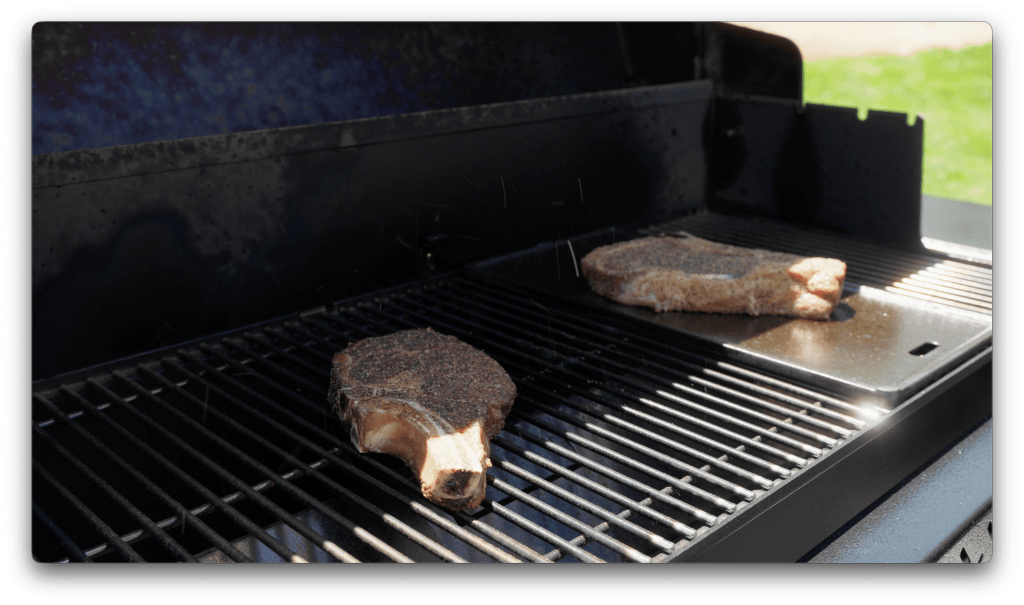
The Weber Searwood XL 600 was set to 600°F, then switched to Manual Mode on setting 10 after it hit temp. Manual Mode runs constant fuel and fan speed and is designed for open-lid cooking.
I tested one ribeye directly on the Weber grates and another on cast iron inside the Weber. Then I tested a ribeye on the Traeger with the lid closed.
I ran the steaks for about 2 1/2 minutes, rotated them, ran another 2 1/2 minutes, then flipped and cooked until they hit about 125°F internal.
The Weber gave me a slightly better crust. It was darker and had a little more sear than the Traeger.
The Traeger did better than I expected, though. It produced a nice-looking steak, and because the lid was closed, it had a redder color from the smoke inside the cooker.
The cast iron on the Weber was the most surprising part, but not in a good way. I let it heat soak after the grill hit 600°F, and I expected more of a ripping hot sear. It worked, but it did not blow me away.
To be fair, there are a few things I would test differently next time. I might run the Weber at 600°F with the lid closed instead of going open-lid Manual Mode. The steaks were also dry-brined in the fridge for 48 hours instead of my usual 24, so they may not have dripped as much fat onto the bars and kicked up as much flame.
Still, based on this test, the Weber had the better searing capability. Not by a mile, but it did have the edge.
Smoking Winner
For smoking, this was close.
The Traeger gave me the juicier, more tender beef rib. The Weber gave me more smoke flavor and better overall bark flavor.
If you served either one to someone, they would be happy. Both racks were delicious. But if I had to choose based on flavor, I would give the slight edge to the Weber Searwood XL 600.
Searing Winner
The Weber wins the searing test.
It gets hotter, has DirectFlame cooking, and gives you Manual Mode for open-lid high heat cooking. The crust was better than the Traeger in this test, even though I still think a dedicated cast iron pan, griddle, charcoal grill, or live fire setup would do a better job than either pellet grill.
The Traeger did better than expected, but the Weber gives you more high heat options out of the box.
Value Winner
This is where the Weber really pulls ahead.
The Traeger Ironwood XL is a more expensive grill. It looks better, has a better touchscreen, includes a nice side shelf, and has a more premium app experience when the Wi-Fi works.
But the Weber Searwood XL 600 costs less, gives you more high heat capability, has slightly more total cooking space, connected to Wi-Fi with no drama, and produced more smoke flavor in my beef rib test.
Even after adding the Weber side shelf and front shelf, I was still below the price of the Traeger.
So Which One Would I Keep?
If I was spending my own money again, I would buy the Weber Searwood XL 600 over the Traeger Ironwood XL.
The Traeger is a really nice grill. I like the way it looks. I like the touchscreen. I like the overall feel of it. And in this test, it made an incredibly tender rack of beef ribs.
But for the price difference, I just do not see enough reason to choose it over the Weber unless you are already deep in the Traeger ecosystem or you simply prefer the Traeger design and app experience.
The Weber gave me better value, better Wi-Fi reliability, more smoke flavor in the ribs, and better searing capability.
My final pick is the Weber Searwood XL 600.
Final Thoughts
This was not a lab test. It was a real backyard cook with two brand new pellet grills, the same pellets, beef ribs overnight, and ribeyes for the high heat test.
Could the results change with different pellets, a longer rest, water pans, Super Smoke, SmokeBoost, or a different steak searing method? Absolutely.
But that is also why I like testing grills this way. Most people are not running perfect lab conditions. They want to know what happens when you cook real food, on a real patio, with real annoyances like Wi-Fi issues, pellet warnings, and family members eating the test samples before you are done filming.
Both grills are good. I would not be upset owning either one.
But if I had to keep one, I would keep the Weber.
Products In This Video
- Traeger Ironwood XL Pellet Grill
- Weber Searwood XL 600 Pellet Grill
- ThermoWorks Thermapen ONE
- ThermoWorks RFX MEAT Wireless Probe
- Beef Plate Ribs
- Ribeye Steaks
- Smokehouse Blend Pellets
- Beefy Beef Rub
- Rum Shaker All Purpose Rub
Other Pellet Grill Reviews
- Best Pellet Smokers
- Yoder YS640S Review
- Kamado Joe Pellet Joe Review
- Beef Ribs Wrap vs No Wrap
- Smoked Beef Short Ribs
- Smoked Brisket
Weber vs Traeger Pellet Smoker FAQ
Is the Weber Searwood XL 600 better than the Traeger Ironwood XL?
In my test, I would choose the Weber Searwood XL 600 because it gave me better value, easier Wi-Fi setup, more smoke flavor on the beef ribs, and better high heat capability. The Traeger Ironwood XL was still excellent and produced the more tender rack of ribs.
Which pellet smoker had better smoke flavor?
The Weber Searwood XL 600 had slightly better smoke flavor in my beef rib test. The difference was not huge, but the Weber ribs had more bark flavor and a little more smoke flavor compared to the Traeger ribs.
Which pellet smoker made more tender beef ribs?
The Traeger Ironwood XL made the more tender and juicy beef ribs in this test. The Weber ribs had more flavor, but the Traeger ribs had the better texture.
Can the Traeger Ironwood XL sear steaks?
Yes, the Traeger Ironwood XL can sear steaks, but it is still a pellet smoker with a 500°F max temperature and no true open-flame sear in this setup. It did better than expected, but I would still prefer cast iron, charcoal, or live fire for the best steak crust.
Can the Weber Searwood XL 600 sear steaks?
Yes, the Weber Searwood XL 600 can sear steaks and had the better crust in this test. It reaches 600°F and has Manual Mode for open-lid cooking, which gives it more high heat flexibility than the Traeger.
Which grill has better Wi-Fi?
In my test, the Weber had much better Wi-Fi performance. It connected quickly and stayed connected throughout the cook. The Traeger was frustrating to connect and disconnected overnight.
Which pellet smoker is the better value?
The Weber Searwood XL 600 is the better value in my opinion. It costs less, has more high heat capability, connected easier, and performed extremely well in both the smoke and sear tests.
Would I still buy the Traeger Ironwood XL?
Yes, if you love the Traeger ecosystem, want the nicer touchscreen, prefer the look, or already own Traeger accessories, the Ironwood XL is still a very good pellet smoker. I just think the Weber Searwood XL 600 gives you more for the money.
